Running diagnostics

Running diagnostics
Showing posts with label Emergency medicine. Show all posts

Tuesday, November 6, 2018

Upper GI Bleeds

As always, this blog post is available in podcast form at www.medonthego.podbean.com. You can also find Med On The Go on iTunes and Google Play! For interest articles, useful quizzes, and funny medical jokes check out our Facebook page at www.facebook.com/drolimedonthego. If you wish to support us, please visit www.patron.podbean.com/medonthego for more details. Thanks!

75% of all gastrointestinal bleeds are classified as upper GI bleeds. An upper GI bleed is defined as a bleeding taking place proximal to the ligament of Treitz, a suspensory ligament where the fourth portion of the duodenum transitions to the jejunum.

Etiology
·      Above the GE junction
o   Epistaxis
o   Esophageal varices (10~30%)
o   Esophagitis
o   Esophageal cancer
o   Mallory-Weiss tear (10%)
·      Stomach
o   Gastric ulcer (20%)
o   Gastritis (20%)
o   Gastric cancer
o   Gastric antral vascular ectasia (rare condition where small blood vessels are dilated around the antrum of the stomach—resulting in “watermelon stomach”; associated with cirrhosis, chronic kidney failure, and collagen vascular disease.)
o   Dieulafoy’s lesion (very rare where a large, tortuous arteriole in the submucosa of the stomach erodes and bleeds)
·      Duodenum
o   Ulcer in bulb (25%)
o   Aortoenteric fistula: rare and lethal; usually only if previous aortic graft has been done
·      Coagulopathy (drugs, renal disease, liver disease)
·      Vascular malformation

Clinical features includes patient noticing blood is coming out his/her GIT. This can be in a variety of forms. In order of decreasing severity of the bleed: hematochezia (blood—usually fresh—passed through anus, can be along with or mixed in stools), hematemesis (vomiting up blood—usually fresh), coffee ground emesis (vomiting old blood), melena (old blood passed through anus), and occult blood in stool.

ALWAYS ask about NSAID, aspirin, or anticoagulant drug use!

Initial management
1.     Resuscitate patient with 2 large bore IVs, IV fluids, monitor vital signs
2.     Send blood for CBC, cross and type, platelets, prothrombin time (PT), partial thromboplastin time (PTT), electrolytes, BUN, creatinine, and liver function tests.
3.     Keep the patient fasting
4.     NGT can be considered to determine upper vs. lower GIT bleeding
5.     Endoscopy is done to establish bleeding site and treat lesion
·      For bleeding peptic ulcers, the most commonly used method of controlling bleeding is injection of epinephrine around bleeding point and thermal hemostasis via bipolar electrocoagulation or heater probe. Less often thermal hemostasis may be used alone. Injection alone is not recommended
·      Endoclips
·      Hemospray—mineral blend powder specifically used for endoscopic hemostasis. It absorbs water to form a cohesive and adhesive mechanic barrier around the bleeding site.
6.     Administer PPI (IV) to decrease the risk of rebleeding if endoscopic predictors of rebleeding are seen
·      PPI is given to stable the clot, not to accelerate ulcer healing
·      If given before endoscopy, it decreases need for endoscopic therapeutic intervention
7.     For variceal bleeds, administer octreotide 50 micrograms loading dose followed by constant infusion of 50 micrograms/hour
8.     Consider IV erythromycin or metoclopramide to accelerate gastric emptying prior to gastroscopy to remove clots from stomach.

Review—PT vs. PTT
Both PT and PTT are tests done to assess whether the patient has a coagulation problem. PTT stands for partial thromboplastin time (sometimes also called activated partial thromboplastin time APTT) and measures the function of the intrinsic coagulation pathway; PT stands for prothrombin time and measures the function of the extrinsic coagulation pathway. The way to remember the difference is this: the 2 T are no longer together à they are “exes” à PT measures extrinsic pathway. Why are they not together anymore? Because one of them got the “7 year itch” à PT/extrinsic pathways deals with factor VII while PTT deals with all other factors.


Prognosis
·      80% stop spontaneously
·      Peptic ulcer rebleeding occurs in 25% of patients. If there is no rebleeding, mortality is low 2%; however, it rises to 10% if rebleeding occurs.
·      Endoscopic predictors of rebleeding includes: spurt or ooze, visible vessel, or fibrin clot
·      H2-antagonists have little impact on rebleeding rates and need for surgery
·      Esophageal varices have a high rebleeding rate (55%) and mortality (29%)
·      Patients can be sent home if:
o   They are clinically stable
o   Bleeding was minor
o   No comorbidities

o   Endoscopy shows clean ulcer with no predictors of rebleeding

Wednesday, February 28, 2018

Consent (as applicable in Canada)

As usual, this blog post is available in podcast form. Look for Med On The Go on Podbean (www.medonthego.podbean.com) , iTunes, and Google Play. If you haven't already done so, check out our Facebook page at www.facebook.com/drolimedonthego. If you would like to support us, please visit www.patron.podbean.com/medonthego for more details.

Medico-legal issues are such “downers” to talk about, but in this day and age it really needs to be discussed because we all want outcomes that are safe and fair for all parties involved. Since I’m hoping to practice medicine in a different country than the one I was trained in, it’s especially important for me to learn about the laws and regulations in Canada.

According the Canadian Medical Protective Association (CMPA) three criteria required for informed consent:
1.     Patient must have the mental capacity to understand the nature and possible consequences of the procedure/treatment.
2.     The patient must be fully informed about the procedure/treatment.
a.     The physician should disclose the diagnosis.
b.     The physician should disclose the nature of the proposed investigation/treatment.
c.      The physician should disclose the expected consequences for forgoing the proposed investigation/treatment.
d.     The physician should disclose reasonable alternatives to the proposed investigation/treatment.
e.     The physician should disclose any material risks of the proposed investigation/treatment and answer questions posed by the patient.
                                               i.     Not every possible complication needs to be conveyed to the patient.
                                              ii.     Complications that occur frequently should be disclosed.
                                            iii.     Complications, however rare, with significant consequences for the patient (e.g. death, paralysis) need to be disclosed.
                                            iv.     Risks that a reasonable person in the patient’s position would consider significant should also be disclosed.
3.     The consent must be given voluntarily

The consent form itself does not equal real consent. The explanation given by the physician and the dialogue between physician and patient about the proposed procedure/treatment is the all-important element of the consent process (no explanatory pamphlet/video can replace this, but if supplementary material was provided it should also be documented). A signed form will be of relatively little value later if the patient can convince a court that the explanations were inadequate or absent. A summary of the consent discussion entered into the medical record at the time is the best defense against an allegation of lack of informed consent; the documentation of the consent discussion need not be lengthy or detailed. The physician can delegate the responsibility of obtaining consent to a colleague, medical trainee, or nurse who has the knowledge and experience to provide information tailored to the requirements of the patient and circumstances.

In witnessing a signature, the witness simply confirms the identity of the patient who signed the document and that the person’s mental state at the time appeared to allow for an understanding of what was signed. The witness has no obligation to provide pre-treatment explanations and is in no way attesting to the adequacy of the explanations given by the physician.

If a surgeon at a teaching hospital delegates certain surgical procedures to his/her trainees, he should disclose to patients the involvement of trainees in these procedures.

Battery in the medico-legal context is when a physician carries out an investigation/treatment in the absence of valid consent or when treatment went beyond or deviated significantly from that for which consent was given. Assault and battery may also apply when consent was obtained by way of serious misrepresentation.

In the emergency department, however, consent is not needed when a patient is at imminent risk of serious injury AND obtaining consent is either not possible or would increase risk to the patient. This rule assumes that most people would want to be saved in an emergency. However, a capable and informed patient can refuse treatment or part of treatment (even if it is life-saving); and emergency treatment CANNOT be initiated if a competent patient has previously refused the same or similar treatment (for same problem) and there’s no evidence to suggest he has changed his mind or an advanced directive (such as DNR) is available. Refusal of help in a suicide situation still warrants treatment. When in doubt, initiate treatment; it can be withdrawn at a later time.

Children presenting to the ER are treated in the same way: treat immediately if the patient is at imminent risk. The patient does NOT have to reach age of majority to give a valid informed consent. However, if the patient in question is obviously not capable to make a decision (like a baby or toddler), parents/guardians have the right to make treatment decisions; if they refuse treatment that is life-saving or will potentially alter the child’s quality of life, Children’s Aid Society (CAS—there is one in every hospital) must be contacted, in which case the consent of CAS is needed to treat.

Common issues needing consent include HIV testing and administration of blood products. Jehovah’s Witnesses are the most common group who will have issues with latter; they may refuse all blood products (even autologous), in which case treatment needs to provide the highest possible quality of care with out the use of blood products (e.g. crystalloids for volume expansion like hydroxyethyl starch). They will generally sign hospital forms releasing medical staff from liability.

An extension of informed consent is the topic of informed discharge. During informed consent, patients are informed of what can potentially go wrong; during informed discharge, patients are informed of the symptoms and signs that would indicate something wrong may be happening. They should also be given a sense of urgency of the response required and where best to seek medical attention. The information should be tailored to each patient and clinical situation.


In the emergency room setting, for many patients there are diagnostic uncertainty on an initial/subsequent visits. These patients should be made aware of this uncertainty—what is known and what is unknown—so that any continuation, escalation, or change in symptoms may prompt reevaluation. Just like informed consent, a discussion between physician and patient is warranted; any detailed explanatory pamphlet or video would not suffice. Documentation of the advice provided on discharge should be documented in the medical records.

Thursday, February 22, 2018

Altered Level Of Consciousness

Today's post is also available in podcast form; visit www.medonthego.podbean.com to stream or download!

If you haven't already done so, also check out our Facebook page www.facebook.com/drolimedonthego --it has some hilarious medicine-related jokes and some useful, applicable articles too. If you wish to support us, please see www.patron.podbean.com/medonthego for more details!

Altered mental status is a collective, non-specific term referring to change in cognitive function, behavior, or attentiveness. It includes delirium, dementia, lethargy (state of decreased awareness and alertness i.e. patient may appear wakeful), stupor (unresponsive but rousable), and coma (sleep-like state, not rousable to consciousness).

Possible causes of coma (AEIOU TIPS)
Acidosis/alcohol
Epilepsy
Infection
Oxygen (hypoxia)/opiates
Uremia
Temperature/trauma (esp. to head)
Insulin (too little or too much)
Psychogenic/poisoning
Stroke


Remember “GCS < 8 intubate!” Ability to protect airway is first priority.

History
·      Obtain collateral from family, friends, police, paramedics, old charts, or Medic Alert bracelets etc.
·      Onset and progression
o   Antecedent trauma, seizure activity, fever
o   Abrupt onset suggests CNS hemorrhage/ischemia or cardiac cause
o   Progression over hours to days suggests progressive CNS lesion or toxic/metabolic cause
·      Determine patient’s baseline level of consciousness
·      Past medical history, paying attention to similar episodes, overdose, or concurrent psychiatric disorders (e.g. depression).

Physical examination
·      Vital signs including temperature
·      Cardiac, respiratory, and abdominal exams
·      Complete neurological exam
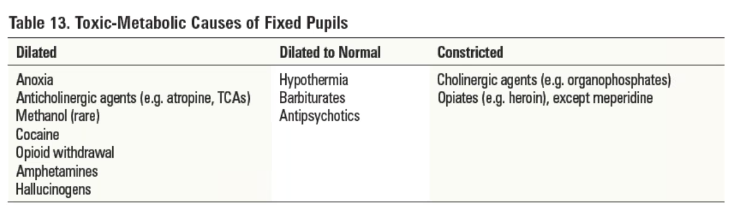
o   Pupil size and reactivity
o   GCS

Investigations
·      Blood work—rapid blood sugar, CBC, electrolytes, creatinine, BUN, liver function test, glucose, serum osmolality, venous blood gas, coagulation studies, troponins
·      Imaging—CXR, CT head
·      Other tests—ECG, urine analysis, urine toxicology

Diagnosis
·      Administer appropriate universal antidotes
o   Thiamine 100mg IV if history of alcoholism or patient looks malnourished
o   One ampule D50W IV if low blood sugar
o   Naloxone 0.4~2mg IV or IM if opiate overdose is suspected
·      Distinguish between structural and toxic-metabolic coma
o   Structural coma
§  Pupils, extra-ocular movements, and motor findings are usually asymmetrical
§  Look for focal or lateralizing abnormalities
o   Toxic-metabolic coma
§  Dysfunction at lower levels of the brainstem (e.g. caloric unresponsiveness)
§  Respiratory depression in association with an intact upper brainstem (e.g. equal reactive pupils)
§  Extra-ocular movements and motor findings are symmetrical or absent
·      Essential to re-examine frequently because status can change rapidly
·      Diagnosis may become apparent only with the passage of time. Delayed deficit after head trauma suggestive of epidural hematoma (characteristic “lucid interval”).


Disposition
·      Admission if ongoing decreased level of consciousness

·      Discharge if altered level of consciousness is readily reversible; ensure adequate follow-up care

Upper GI Bleeds

As always, this blog post is available in podcast form at www.medonthego.podbean.com. You can also find Med On The Go on iTunes and Google ...